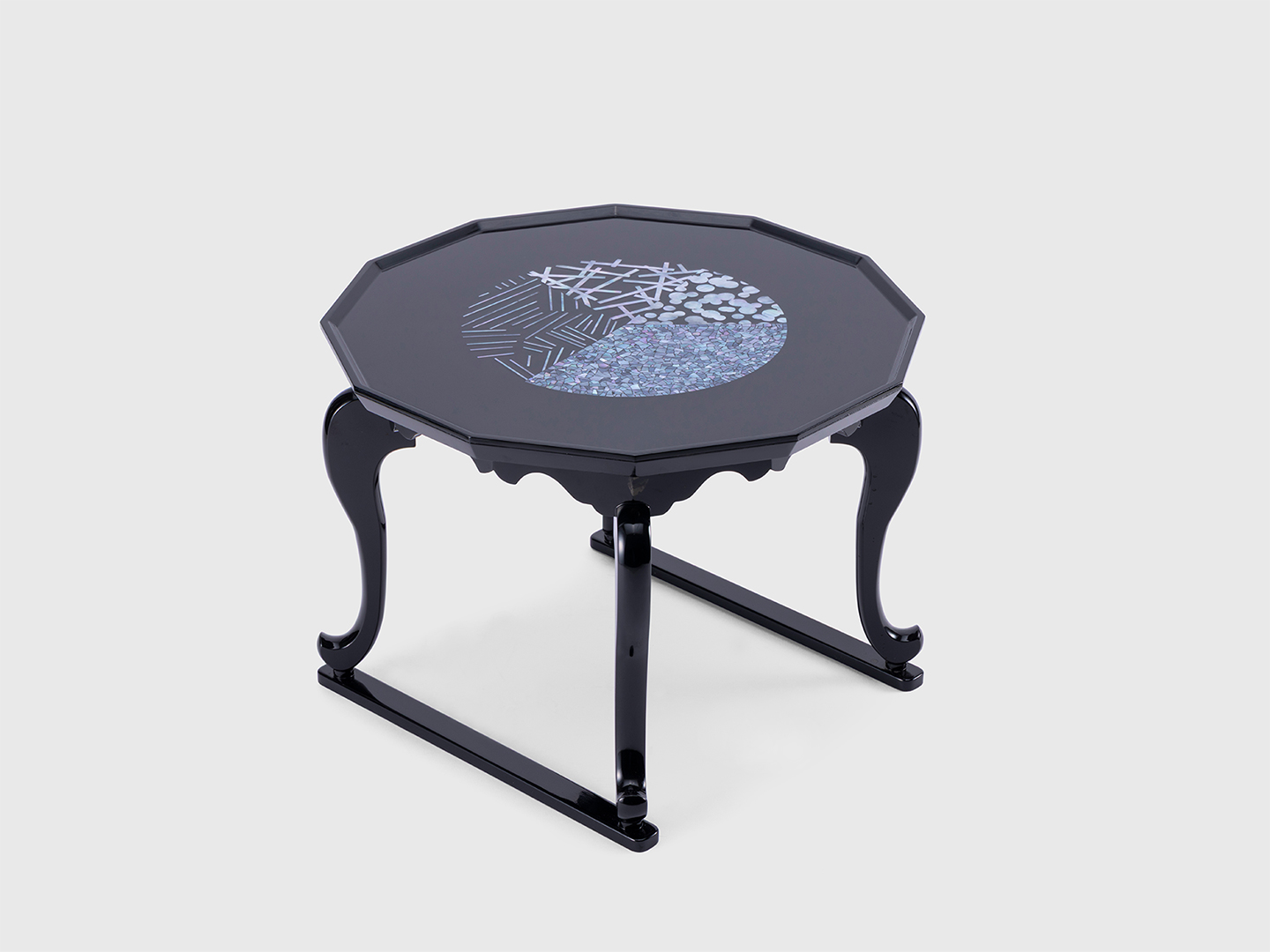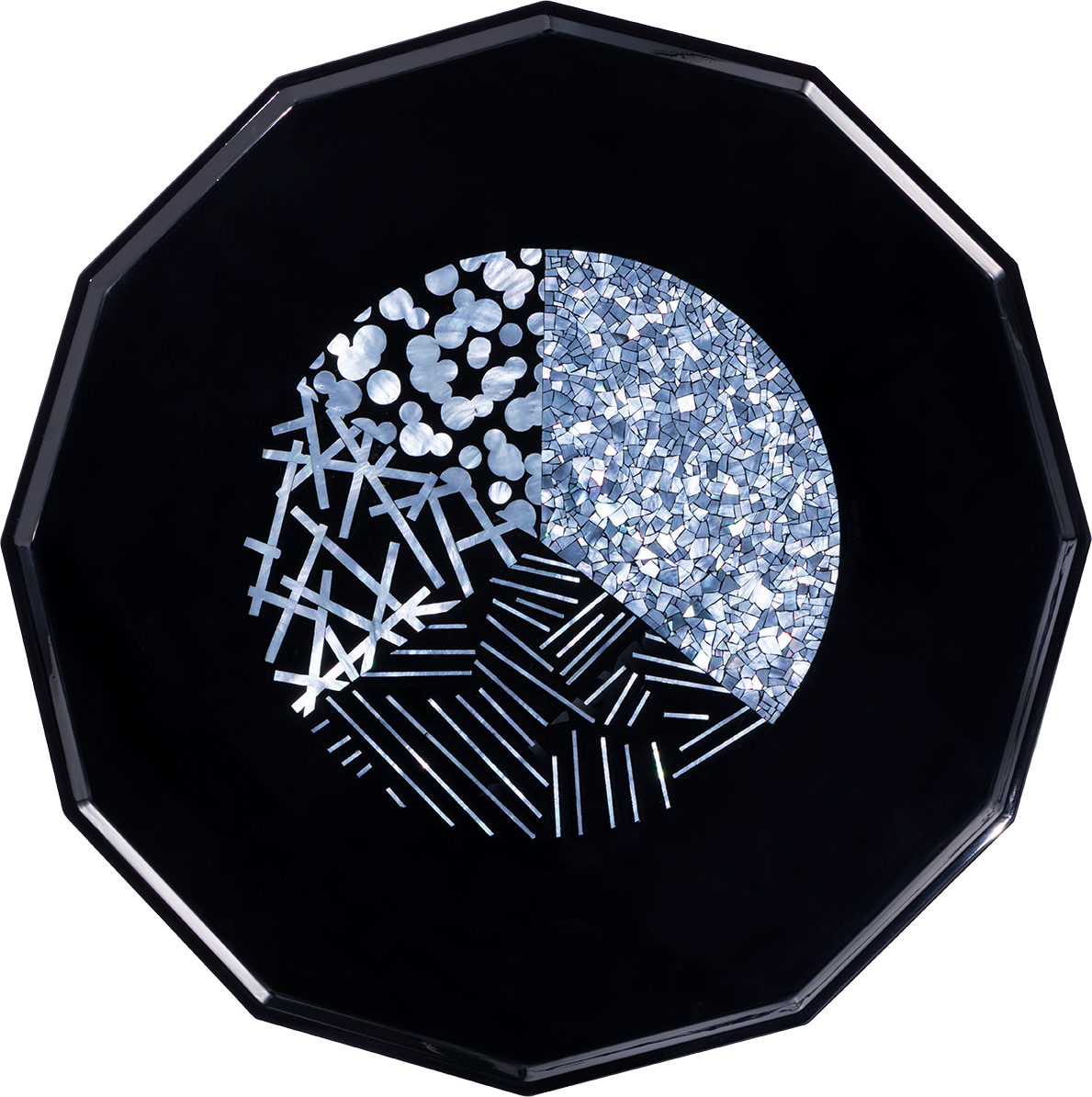
- tabletop artwork
- 2026
- mother-of-pearl lamina on lacquered table
- artwork dia. 224 mm (tabletop dia. 408 mm)
Table per Person per Household
We were invited to create a mother-of-pearl artwork for sobans – small tray-like tables traditionally used in Korea to serve individual diners – to be exhibited in Milan. We based our work on a statistical chart showing the prevalence of single-person households in Korea. Following is our note:
In South Korea, single-person households make up the most common household type. According to a press release from the National Data Agency at the end of 2025, single-person households accounted for 36.1% of all households in 2024. This is a nearly six-point increase from 27.2% in 2015. During the same period, two-person households rose by about 3 percentage points, from 26.1% to 29%; three-person households fell from 21.5% to 18.8%; and households with four or more people fell from 25.2% to 16%.
Some people view single-person households as a sign of isolation. According to the National Data Agency, although 51.1% of single-person households in 2025 reported overall satisfaction with their relationships, this is still lower than the 55.5% satisfaction rate for the entire population.
Meanwhile, as single-person households increase, so does the number of people eating alone, known as “honbapjok.” According to Statistics Korea, the percentages of people eating lunch and dinner alone reached 26.9% and 25.7% in 2024, respectively, showing a rise of 1.4 to 2.9 percentage points from 2019. While delivery food adapts to this trend, offline stores still lag; only 10.4% of restaurants offer single-person menus.
According to the Encyclopedia of Korean Culture, soban (小盤), small tableware used for serving food, was primarily used for single-person dining rather than for two or more people during the Joseon Dynasty.
- Project type:
- miscellaneous
- Commissioned by:
- Seoul Design Foundation
- Production by:
- Yeobijin
- Exhibited as part of:
- Seoul Life 2026 Milan – Heritage Reimagined, Soban (ADI Design Museum, Milan, 2026)